When Switching Jobs: How to Calculate Offered Hike

Knowing how to calculate offered hike when switching jobs helps you judge a new offer with confidence. A job switch hike is the percentage increase between your current CTC and the offered CTC. One simple hike percentage formula reveals whether the offer is fair, average, or weak. A salary hike calculator speeds this up, yet the manual method lets you verify every figure. Accurate numbers also strengthen your salary negotiation before you sign the offer letter. This guide explains each step, with examples, a hike chart, and the mistakes to avoid.
Why Calculating the Offered Hike Matters Before You Switch
A new offer often looks attractive because the headline number is higher. However, only the hike percentage shows how much you truly gain compared with staying put. Employees usually negotiate a bigger hike during a job change than during an internal appraisal. Calculating the offered hike before you resign protects you from accepting a weak offer or missing room to negotiate.
Understanding Current CTC and Offered CTC
Your current CTC is the total annual package, including base salary, variable pay, bonuses, and allowances. The offered CTC should be broken down the same way. If you compare only fixed pay against a total package, the hike percentage will mislead you. Ask the recruiter for the full salary structure, then line up each component side by side before calculating.
The Core Formula for Offered Hike Percentage
The offered hike percentage equals the new salary minus the old salary, divided by the old salary, multiplied by 100. In formula form, Hike % = ((New − Old) ÷ Old) × 100. If you know the percentage instead, New Salary = Current Salary × (1 + Hike% ÷ 100). Both formulas work for monthly or annual figures, provided you use the same pay period.
Step by Step: Calculating Your Offered Hike
First, note your current CTC from your latest salary slip or revision letter. Second, take the offered CTC from the offer letter. Third, subtract the old figure to find the increment amount. Fourth, divide by the current CTC and multiply by 100. For hourly roles, $25 per hour rising to $28 per hour is a 12 percent increase.
Working Backward to Set Your Expected CTC
Sometimes you know the hike you want but not the number to request. Multiply your current CTC by one plus the expected percentage as a decimal. A 30 percent hike on ₹6,00,000 means multiplying by 1.30, giving ₹7,80,000. This multiplier method helps you set a target CTC before the negotiation call begins.
Offered Hike Percentages on a ₹6,00,000 CTC
| Hike Percentage | Multiplier | New CTC |
|---|---|---|
| 10% | x 1.10 | ₹6,60,000 |
| 15% | x 1.15 | ₹6,90,000 |
| 20% | x 1.20 | ₹7,20,000 |
| 25% | x 1.25 | ₹7,50,000 |
| 30% | x 1.30 | ₹7,80,000 |
| 40% | x 1.40 | ₹8,40,000 |

A Worked Example Using Real Offer Figures
Suppose your current CTC is ₹6,00,000 and the offered CTC is ₹7,50,000. The increment amount is ₹1,50,000. Dividing by ₹6,00,000 and multiplying by 100 gives a 25 percent hike. Checking the reverse way, multiplying ₹6,00,000 by 1.25 returns ₹7,50,000, so the calculation is confirmed from both directions.
Why Offered Hike Differs From In-Hand Salary Gain
A CTC hike does not raise in-hand salary by the same percentage. PF contributions grow with basic pay, a higher income may enter a bigger tax slab, and a changed salary breakup alters the take-home amount. Employees may also need to review tax-saving investments, HRA exemptions, and their tax regime. Always estimate net pay before judging the offer.
Common Mistakes When Comparing Two Offers
Common errors include comparing fixed pay with total CTC, mixing monthly and annual figures, and counting an uncertain bonus as guaranteed income. Others divide by the new salary instead of the old salary. Some candidates ignore joining terms, notice period, and benefits. Compare two offers side by side using identical components so the hike percentage reflects real value.
Comparing Your Offer With Typical Job Switch Hikes
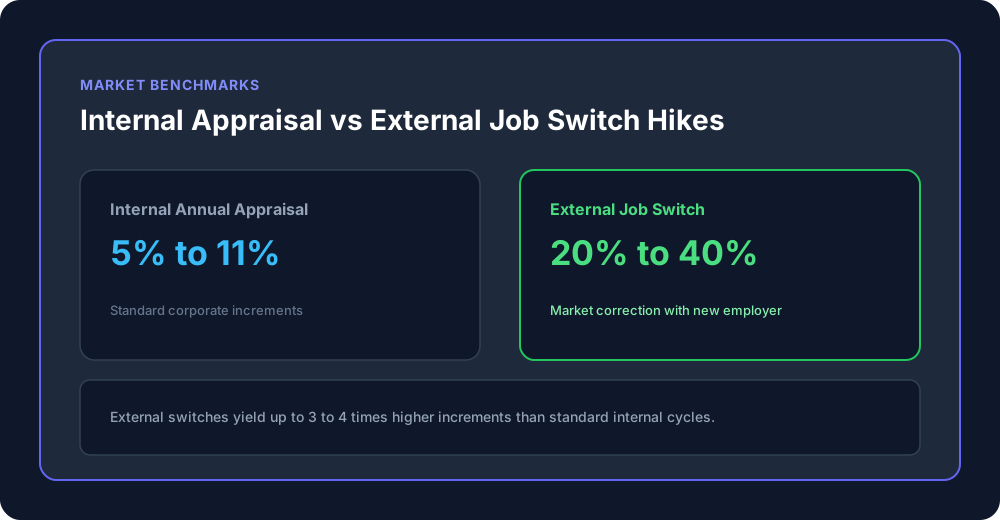
Market data gives your hike meaning. Reported ranges for a job switch vary by source, from roughly 10 to 40 percent, while internal appraisals usually land lower. IT and finance often pay higher increments than manufacturing or education. These figures are market estimates rather than guarantees, so weigh your experience level, industry, and role before judging the offered hike.
Quick Reference Chart for Offered Hike Percentages
The chart above lists the multiplier and new CTC for each common hike percentage. A 20 percent hike on ₹6,00,000 gives ₹7,20,000, and a 30 percent hike gives ₹7,80,000. Save this reference table for quick checks when an offer arrives. Use a salary hike calculator for exact decimals, then keep the result with your offer letter for future reference.
Conclusion
Calculating the offered hike is quite simple once you know the formula. Subtract your current CTC from the offered CTC, divide by the current figure, and multiply by 100. Compare like with like, estimate your in-hand salary, and check typical market ranges before you decide. Keep your calculation with the offer letter, and use it confidently during negotiation with the recruiter before you finally switch jobs for a better package.