How to Calculate Percentage Hike From Base Pay
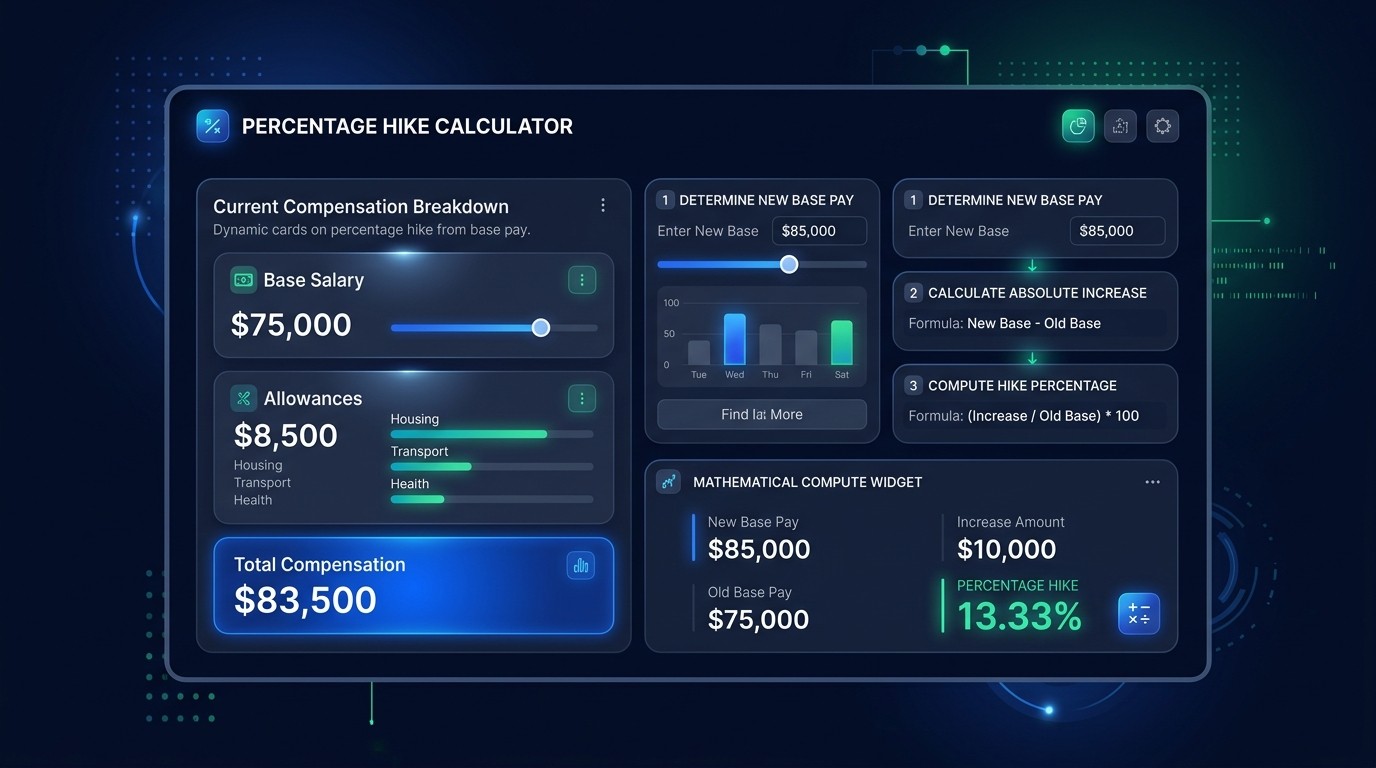
Learning how to calculate percentage hike from base pay shows exactly how much your salary has grown. Base pay is the fixed part of your compensation, so it gives the cleanest starting point for any increment calculation. A simple hike percentage formula compares your old salary with your new salary. A salary hike calculator delivers the answer instantly, yet knowing the manual steps helps you catch errors. Accurate figures also support appraisal discussions, job offer comparisons, and monthly budget planning. This guide covers each step, with examples, a hike chart, and the mistakes to avoid.
Why Base Pay Is the Starting Point for a Hike
A salary hike, also called a salary increment, is an increase in your current compensation expressed as a percentage. Organisations grant it during annual appraisals, promotions, market corrections, or retention adjustments. Starting from base pay keeps the comparison fair, because bonuses and allowances can vary each year. Knowing the exact percentage also helps you negotiate with confidence.
Understanding Base Pay vs Gross Pay and CTC
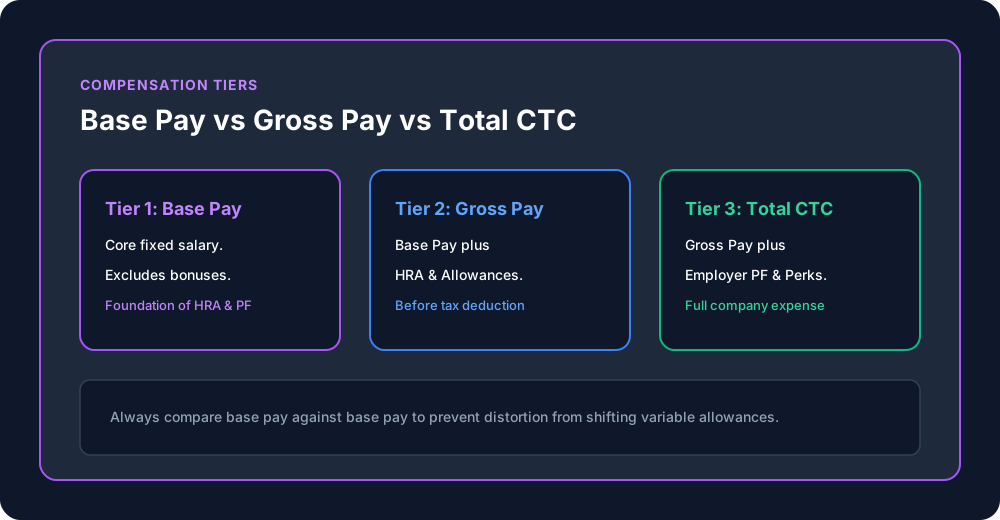
Base pay is the fixed salary before allowances and bonuses. Gross pay adds those extra components, while CTC includes employer contributions such as PF as well. Each figure produces a different hike percentage, so choose one and apply it to both old and new values. For a clean base pay hike, compare base salary with base salary only.
The Core Formula for Percentage Hike
The percentage hike formula has two forms. To find the new salary, use New Salary = Current Salary + (Current Salary × Hike % ÷ 100). To find the hike percentage from two figures, subtract the old salary from the new salary, divide by the old salary, and multiply by 100. Both formulas work for monthly or annual base pay.
Step by Step: Calculating Hike From Base Pay
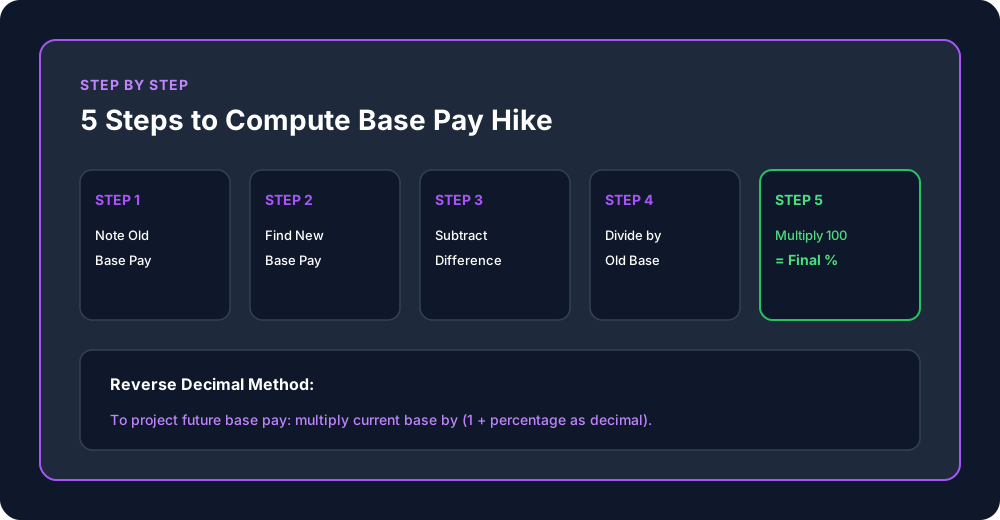
First, write down your old base pay. Second, note the new base pay from your revision letter. Third, subtract to get the difference. Fourth, divide that difference by the old base pay. Fifth, multiply by 100 to get the percentage. For instance, ₹20,000 rising to ₹25,000 is a ₹5,000 gain, which equals a 25 percent hike.
Working Backward to Find Your New Base Pay
When the hike percentage is known, convert it into a decimal first, so 20 percent becomes 0.20. Multiply your base pay by that decimal to get the increment amount, then add it to the current salary. A 30 percent hike on ₹20,000 gives an increment of ₹6,000 and a new base pay of ₹26,000. This reverse method helps you set a target salary.
Common Hike Percentages on a ₹50,000 Base Pay
| Hike Percentage | Multiplier | New Base Pay |
|---|---|---|
| 10% | x 1.10 | ₹55,000 |
| 15% | x 1.15 | ₹57,500 |
| 20% | x 1.20 | ₹60,000 |
| 25% | x 1.25 | ₹62,500 |
| 30% | x 1.30 | ₹65,000 |
| 40% | x 1.40 | ₹70,000 |
A Worked Example Using Real Base Pay Figures
Imagine your base pay is ₹50,000 and you receive a 40 percent increase. Multiply ₹50,000 by 0.40 to get ₹20,000. Adding it gives a new base pay of ₹70,000. Checking the result, ₹20,000 divided by ₹50,000, times 100, returns 40 percent, so the calculation is correct from both directions.
Why Base Pay Hike Differs From Total CTC Hike
A base pay hike and a total CTC hike rarely match, because bonuses, allowances, and employer contributions change differently. A higher base salary also raises PF contributions, which affects take-home pay. For example, a ₹5,00,000 CTC with a ₹50,000 bonus has a gross salary of ₹4,50,000 before deductions. Always state which pay component your hike percentage refers to.
Common Mistakes When Calculating Base Pay Hike
Common errors include dividing by the new salary instead of the old salary, mixing monthly and annual figures, and comparing base pay with gross pay. Others forget that deductions such as PF, professional tax, and insurance reduce net pay. Use a salary hike calculator to verify your manual calculation, which removes common hand-calculation errors.
Comparing Your Base Pay Hike With Market Averages
A percentage gains meaning only against benchmarks. Organisations consider performance, role expansion, inflation, and industry salary trends when setting an increment. Compare your hike with the market for your role, experience level, and city. Judging the percentage rather than the final amount also makes offers from different companies easier to compare fairly.
Quick Reference Chart for Common Hike Percentages
The chart above shows the new base pay for common hike percentages on a ₹50,000 salary. A 10 percent hike gives ₹55,000, while a 20 percent hike gives ₹60,000. Bookmark this hike chart for quick checks, and use a salary hike calculator to compare scenarios such as 10, 20, 30, and 40 percent before appraisal talks begin.
Conclusion
Calculating the percentage hike from base pay is quite simple with the right formula. Subtract the old base pay from the new base pay, divide by the old figure, and multiply by 100. Use the simple decimal method to find a new salary from a known percentage. Compare like with like, remember that deductions reduce take-home pay, and verify your answer with a calculator before negotiating your next salary increment.