How to Estimate CTC Hike Percentage After Appraisal
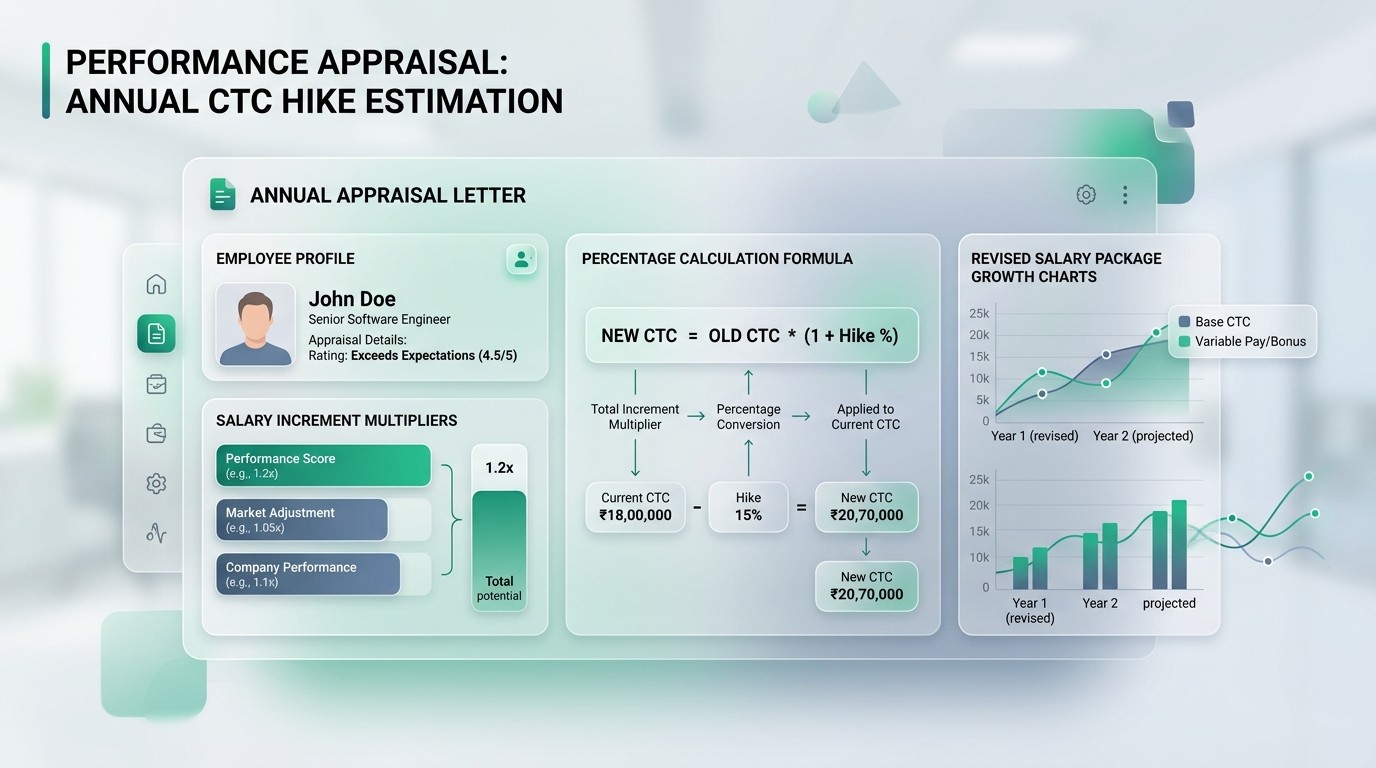
Knowing how to estimate CTC hike percentage after an appraisal helps you judge whether a raise is truly fair. CTC, or cost to company, covers base salary, bonuses, allowances, and benefits, so the increment must be measured on the full package. A simple salary hike formula compares your current CTC with your new CTC. A hike percentage calculator gives the answer instantly, but the manual method lets you verify it. Accurate numbers also strengthen salary negotiation and long-term financial planning. This guide explains each step, with examples, a multiplier chart, and the mistakes to avoid.
Why the Hike Percentage Matters After an Appraisal
A salary hike is an upward adjustment in pay, usually stated as a percentage of your current CTC. The appraisal letter may show only the new figure, leaving you to work out the increment percentage yourself. Knowing the exact number helps you compare the raise with inflation, market rates, and offers from other employers. Without it, a modest raise can look more generous than it is.
Understanding CTC Before You Calculate the Increase
CTC equals base salary plus bonuses, allowances, and benefits. Because each part can change at appraisal time, compare the total CTC before and after, not just one component. Basic salary usually forms about 35 to 40 percent of the package, and it drives HRA, PF, and gratuity. Always list every CTC component before calculating the increment.
The Core Formula for CTC Hike Percentage
The hike percentage formula is simple. Subtract your old CTC from your new CTC to get the increment amount, divide that amount by the old CTC, and multiply by 100. In short, hike percentage equals new minus current, divided by current, times 100. The same increment formula works for monthly salary or annual CTC, as long as both figures use the same period.
Step by Step: Finding Your Hike Percentage
First, note your current CTC before the appraisal. Second, find the new CTC from your revision letter. Third, subtract to find the difference. Fourth, divide by the old figure and multiply by 100. For instance, $60,000 rising to $75,000 is a $15,000 gain, and dividing by $60,000 gives a 25 percent hike.
Working Backward to Find Your New CTC
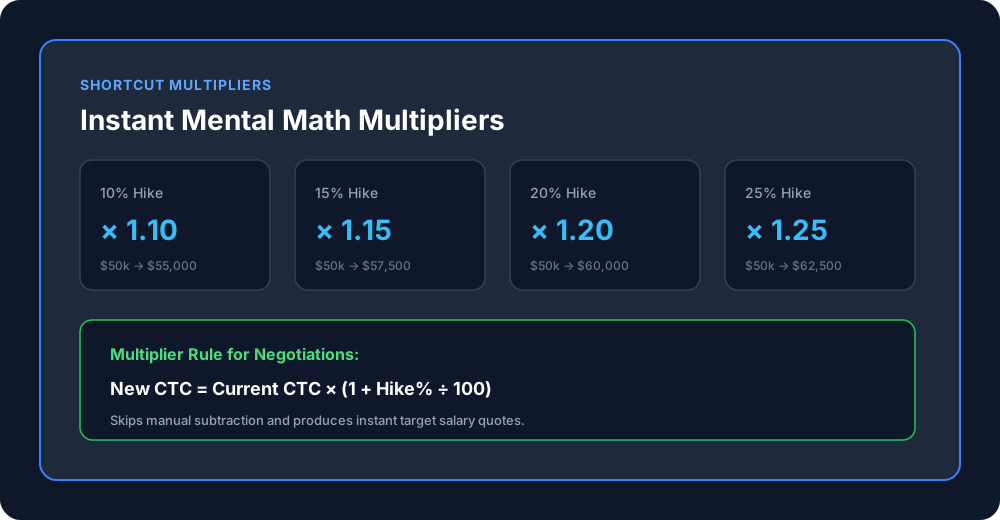
Sometimes the hike percentage is known and the new CTC is not. Multiply your current CTC by one plus the percentage as a decimal. A 30 percent hike on $80,000 means multiplying by 1.30, which gives $104,000. This multiplier method is faster than finding the increment amount separately, and it works for any base salary.
Common Hike Percentages and Multipliers
| Hike Percentage | Multiplier | New CTC on $50,000 |
|---|---|---|
| 10% | x 1.10 | $55,000 |
| 15% | x 1.15 | $57,500 |
| 20% | x 1.20 | $60,000 |
| 25% | x 1.25 | $62,500 |
| 30% | x 1.30 | $65,000 |
| 40% | x 1.40 | $70,000 |
A Worked Example Using Real Salary Figures
Suppose an employee earns $50,000 and receives a 10 percent hike after a performance review. The increment amount is $5,000, so the new CTC is $55,000. Checking in reverse, $5,000 divided by $50,000, times 100, returns 10 percent. Using the multiplier of 1.10 produces the same $55,000 instantly, confirming the calculation from both directions.
Why CTC Hike Differs From In-Hand Salary Increase
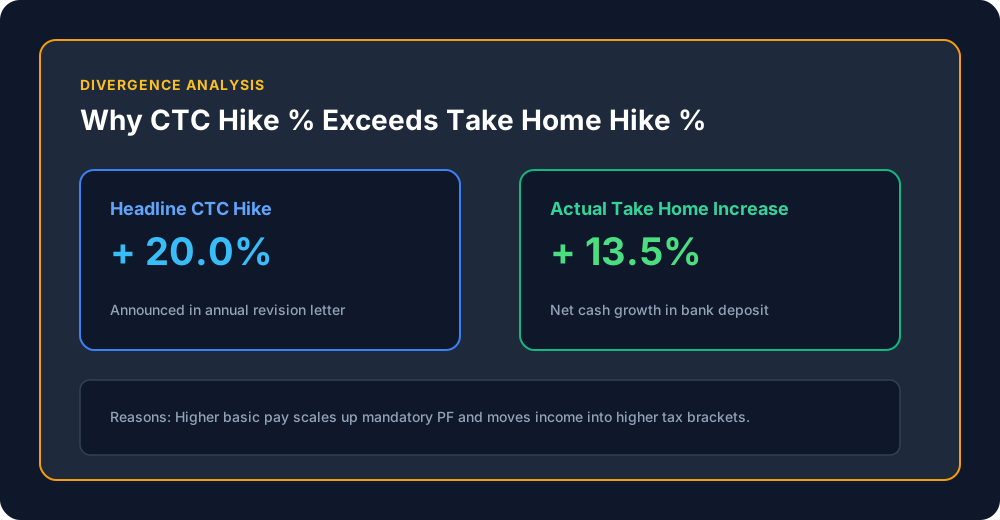
A CTC hike does not equal an equal rise in take-home salary. Higher basic pay increases PF contributions, typically 12 percent of basic from both employee and employer. A larger income can also move you into a higher tax bracket, and a changed salary breakup alters the net amount. Therefore, a 20 percent CTC hike usually delivers a smaller in-hand salary increase.
Common Mistakes When Calculating Your Hike
Common errors include dividing by the new CTC instead of the old CTC, mixing monthly and annual figures, and ignoring variable pay. Others compare headline numbers without adjusting for inflation. Double-check which CTC components were included before sharing your final percentage, because a small input error can distort the hike percentage and your negotiation position.
Comparing Your Hike With Industry Averages
Context turns a percentage into a verdict. Annual appraisal hikes average roughly 5 to 11 percent, while internal raises often fall between 5 and 15 percent. Promotional hikes commonly range from 15 to 30 percent, and job switches usually deliver 20 to 40 percent. Compare your increment percentage with these benchmarks, then consider your performance rating, industry, and company budget.
Quick Reference Chart for Common Hike Percentages
The chart above gives a fast multiplier for each common hike percentage. A 10 percent raise means multiplying by 1.10, and a 25 percent raise means multiplying by 1.25. Keep this reference table handy when you review an appraisal letter or compare job offers. For exact decimals or multi-year projections, use a dedicated CTC hike calculator to confirm your result.
Conclusion
Estimating your CTC hike percentage is straightforward once you use the right formula. Subtract the old CTC from the new CTC, divide by the old figure, and multiply by 100. Use the multiplier method to find a new CTC from a known percentage. Remember that take-home pay rises by less than the headline hike, so compare the result with benchmarks and verify it with a calculator before negotiating your pay.